
The Order Nobody Was Supposed to Change
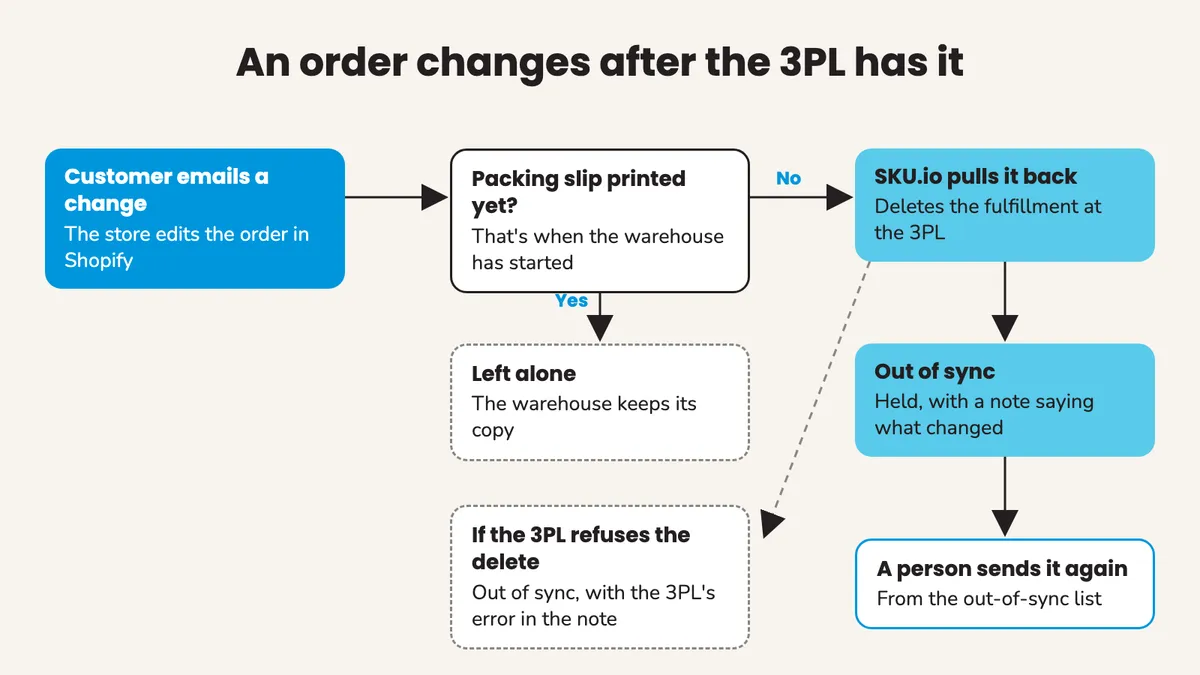
Somebody emails to say they ordered the wrong size, and by then the order is already at the 3PL. In SKU.io, as long as the warehouse hasn’t started on it, which for us means the packing slip hasn’t printed, we delete the fulfillment we sent, mark the order out of sync, and write a note saying why. Then it waits until a person looks at it and sends it again. We don’t edit the warehouse’s copy in place, because the warehouse works from its own copy, and if an edit only half lands the box matches the warehouse and not the store. If the 3PL refuses the delete, the order still goes out of sync and the note carries the 3PL’s error, but the warehouse keeps its copy, and somebody has to sort that one out with the 3PL directly.
In March 2024 a customer messaged us with 47 orders out of sync, most of them new orders, right after they’d cleared the list. The notes back then didn’t say enough to tell why. I shipped a change that afternoon to write the specific reason into them, then reproduced it: a refactor we’d done for a Shopify problem had broken how bundles were handled, and ordinary updates were knocking orders out of sync. I fixed that, found the 23 orders where it had also cancelled lines, and deleted and recreated those.
Last December I went through it with the ops lead of a shaving brand we were onboarding, 7,000 to 9,000 orders a month. They’ve been live since. On that call one of their test orders had cancelled itself because it had the word test in it and we’d left a flag on. They already held each Shopify order for an hour before it went to their 3PL, and we kept that. I’d assumed most changes would land inside the hour. Their 3PL can leave an order in its queue for up to 20 hours, though, and their team changes orders whenever customers email, as long as the warehouse hasn’t started on it. Their estimate was about a dozen orders a business day.
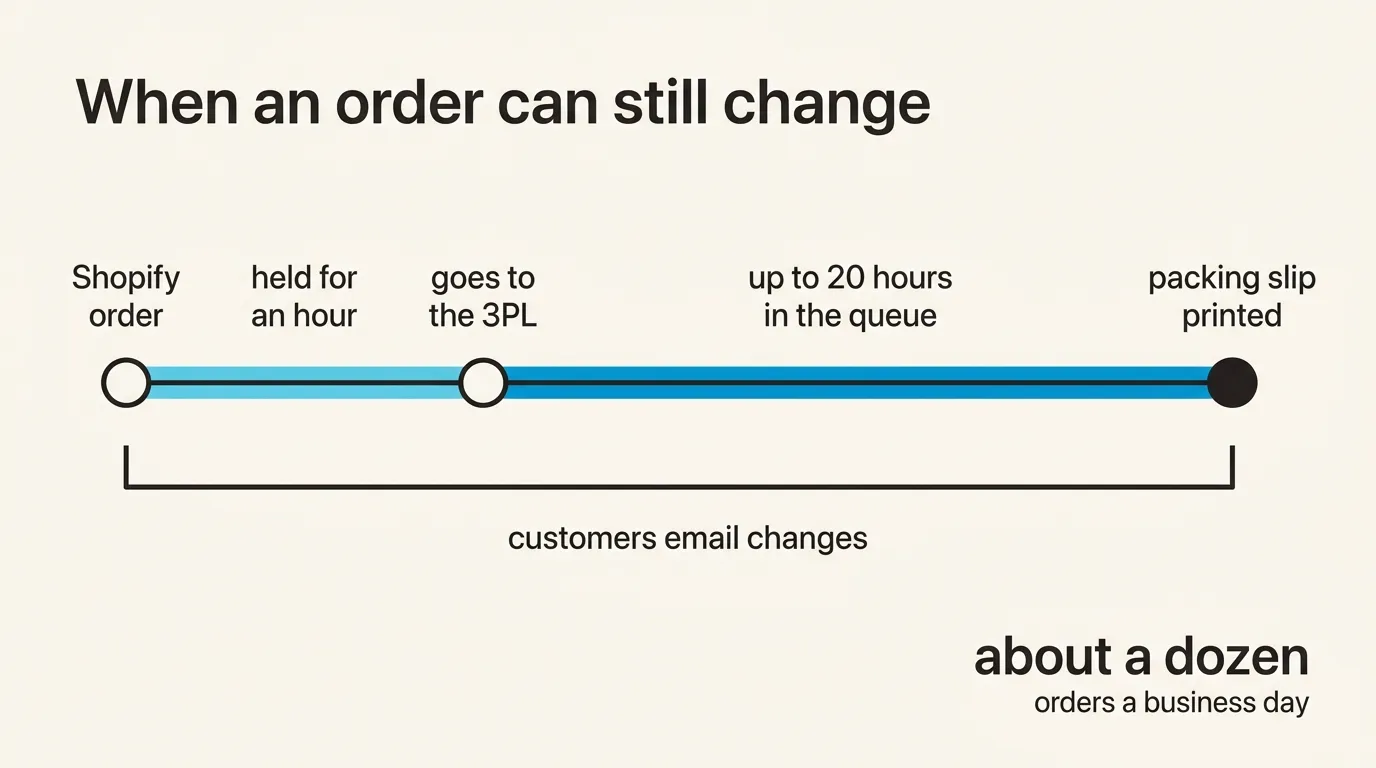
At that rate somebody on their side goes through the out-of-sync list every couple of hours, reads the note on each one, and sends it back. Before us they did roughly the same job inside the 3PL’s own system: put the order on hold, write down why, then answer the customer. When they trialed another tool that didn’t pick up edits at all, each change also had to be typed into that tool by hand.
I run an online store too, and we’re worse. In August our 3PL told me none of their clients touch an order once the warehouse has started on it, and that someone on my team had been going into their system and changing quantities mid-pick.
If orders change after your 3PL has them, book a demo and I’ll show you the out-of-sync list on a demo account.