
Your Recipe Is in Grams. Your Vanilla Comes in Fluid Ounces.
“All of our recipes are in grams,” a buyer told me on a demo on September 21st. “But yet, say we buy vanilla in 16 ounces.”
He runs purchasing and supply chain for a brand whose product is made by a contract manufacturer. The 16 ounces were fluid ounces. The recipe wanted grams.
My first answer was not a good one. I pulled up a product in our demo data that’s bought by the pound and used in grams, and showed him that the recipe already knows how to get from one to the other.
He said liquids don’t work like that. Converting volume to weight depends on the density, and the density depends on the liquid. I asked whether it was at least consistent per recipe. It isn’t, and it was the wrong question. Every syrup he buys has its own density, and so does the vanilla.
So he asked whether he’d have to make something like a vanilla conversion. I said yes, and started making one on screen. I think I named it Vcon. You’d type in how many grams are in one and you’d be done, for vanilla. He let me get that far and then said he hadn’t seen fluid ounces anywhere in our units either. We had ounces by weight. Not by volume.
Then he described what happens today. Someone looks up the density on Google, works it out on a calculator and types in the result. When nobody has, the bottles get received and the recipe can’t draw on them. Somebody asks to change the unit on the purchase order. The supplier says they don’t sell it that way. He called it cumbersome. He also said, fairly, that the math itself is easy. I said the point of keeping it in the system is that whoever’s receiving doesn’t have to stop and do it every time, and he finished the thought: go to the calculator and say, this is in ounces, I have to convert it.
He said he was surprised other customers hadn’t asked for this. I told him it was “the first time I’ve come across it.” I have never done manufacturing in my own business and I’d said as much to other buyers. The manufacturing side of SKU.io is the part I know least from the inside, and this is what that looks like.
I asked if he’d rather enter a final conversion for each ingredient or enter the density and have the system work it out. He wanted the system to do it. He also asked whether an AI could look the density up.
All of that is in the product now, with one difference. The US fluid ounce is a standard unit. An ingredient can carry a density, in whatever units you have it, and it’s checked against a sensible range after it’s been converted to grams per milliliter, so a pounds-per-gallon figure typed into the grams-per-milliliter box gets caught. The weight-to-volume conversions for that ingredient are then worked out from the density, and changing the density tells you which recipes are affected. If you’ve weighed a bottle and trust your own number more, you can enter that one conversion by hand as an override, and the density stops touching it.
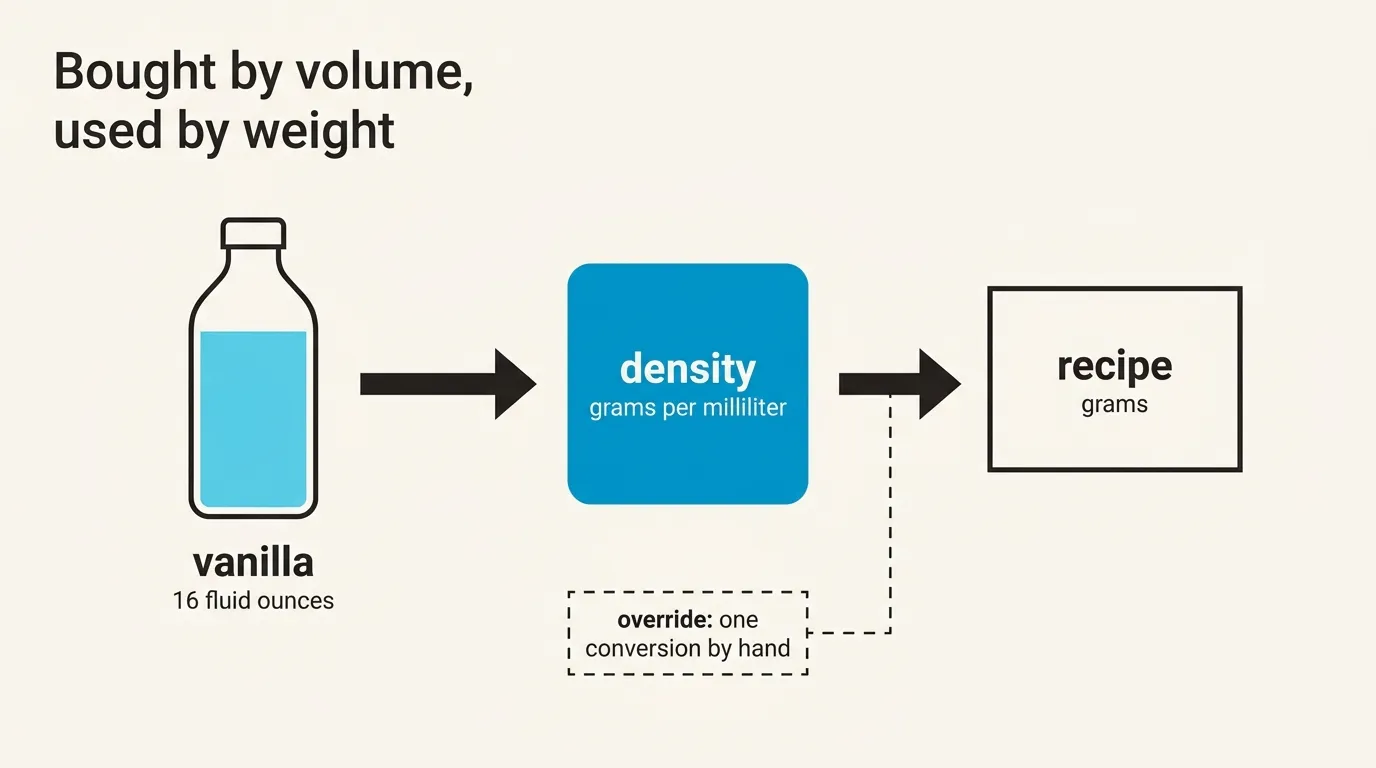
The difference is the AI lookup. There’s a button, and it suggests a density. It doesn’t save one. Somebody has to accept it, and what they accepted is written to the product’s history. He’d have been happy with it filling the number in. I wasn’t, because his ingredients go to a plant his company doesn’t run, and a density nobody looked at would quietly make the stock count and the cost of every batch made there wrong.
His operations lead had told me the week before that moving production out hadn’t made the system less necessary. “We’re still ordering our raw materials,” she said. The vanilla gets bought by the brand, in fluid ounces, and shipped to the manufacturer. The recipe there uses it in grams.
The same call turned up that you couldn’t import or export recipes either. That went on the list the next morning.
A recipe is also only what you expect to use. What the floor actually used is a separate number, and that one is what the unit gets costed at.
If you buy by volume and use by weight, book a demo and bring the ingredient that gives you the most trouble.