Connect BigCommerce
You connect BigCommerce with a store-level API account that you create in your BigCommerce control panel. SKU.io needs the account's Store Hash and Access Token. Once connected, you map your BigCommerce locations to warehouses and choose what syncs.
Before you begin
- You need admin access to the BigCommerce store, and permission to connect integrations in SKU.io.
- Decide which SKU.io store this BigCommerce store sells through.
Create the API account in BigCommerce
-
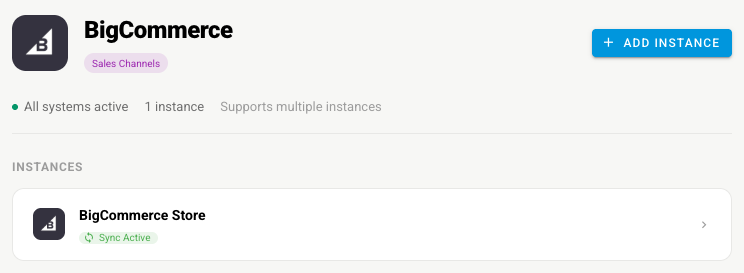
Go to Apps & Integrations, open Sales Channels, and choose BigCommerce.
-
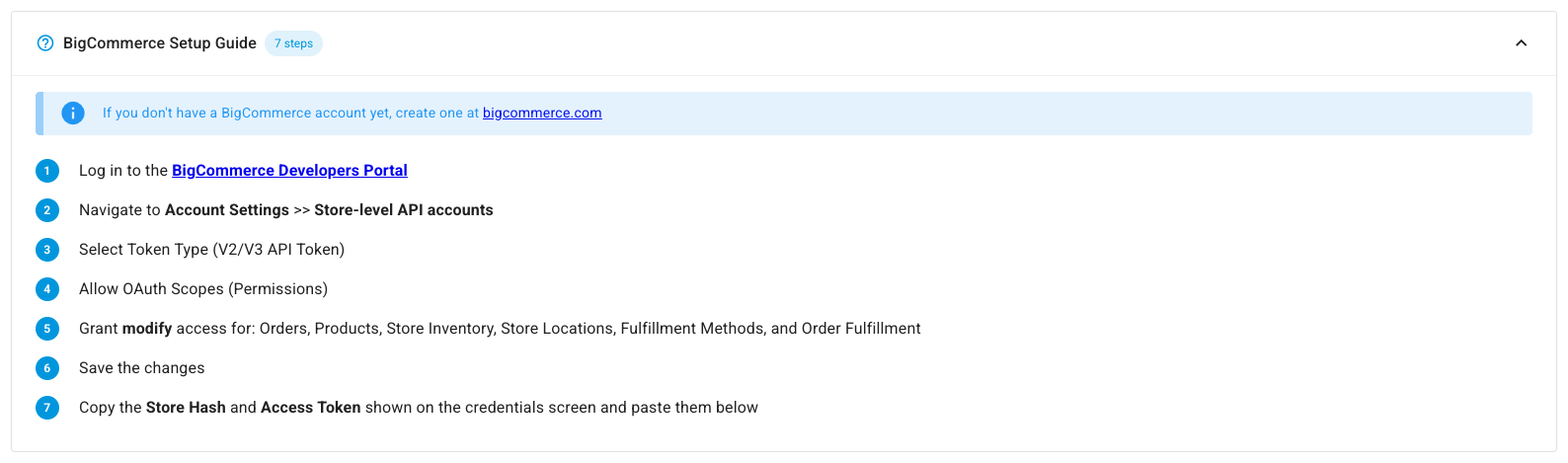
Click Connect BigCommerce, or Add Instance if a store is already connected. The New BigCommerce Integration page opens with a BigCommerce Setup Guide.
-
In BigCommerce, follow the guide: go to Account Settings → Store-level API accounts, create an account with a V2/V3 API Token, and grant modify access for Orders, Products, Store Inventory, Store Locations, Fulfillment Methods, and Order Fulfillment.
-
Save it, and copy the Store Hash and Access Token BigCommerce shows.
Enter the details in SKU.io
-
Under Basic Information, type an Integration Name and pick the Store.
-
Under API Credentials, paste the Store Hash (the part between
stores/and/v3in your API path) and the Access Token.
-
Under Advanced Settings, set the Start Date, and choose Auto Link Products, Auto Create Products, and Automatic Sync.
-
Optionally pick this channel's accounts under Accounting. You can change them later under Channel Accounting.
-
Click Connect with BigCommerce.
If the token changes later, paste the new one under Settings → Authentication.
Map locations to warehouses
Each BigCommerce location must be mapped to a SKU.io warehouse before its orders route there and its stock syncs.
- Open Settings → Warehouse Mappings.
- Click Refresh Locations to download your BigCommerce locations.
- Pick a SKU.io warehouse for each location, and save.
Then open Settings → Inventory Sync to set how stock is sent per location.
Choose what syncs
- Open Settings → Sync.
- Under What syncs, turn each capability on or off: importing orders, creating SKU.io sales orders from them, and importing products; and sending tracking, stock, and prices.
Review the other settings
| Settings tab | What to check |
|---|---|
| General | The name, the store, Auto Create Products, and whether to Email Customers |
| Orders | The start date and Allow refunds from SKU |
| Pricing Sync | Master of Price, which price to send, and guardrails. See Sync prices with your sales channels |
| Shipping | Which SKU.io shipping method each BigCommerce shipping method becomes. Methods appear once orders import |
| Content Sync | Whether SKU.io watches your products for content changes. See Content Sync |
| Accounting | The Payment Cost % used to estimate profit on each order |
Next steps
- BigCommerce overview — what moves each way.
- Manage a connected app — pause one direction without stopping the rest.