Record a product's HS code and country of origin
Each product can carry two trade-compliance fields: its HTS Code (the Harmonized Tariff Schedule code, the national form of the international HS code) and its Country of Origin, where it was made. Keep them on the product so every export, channel listing and integration that needs them reads the same values.
Before you begin
- You can edit products.
- Know each product's tariff code and country of manufacture. Your customs broker or the supplier's commercial invoice usually has both.
Set them on one product
- Open the product. The Overview section opens.
- On the Product Details card, click Edit.
- In HTS Code, enter the code exactly as you file it, for example
9617.00.1000. It's stored as text, so dots and leading zeros are kept. - In Country of Origin, choose the country. SKU.io stores it as the country's two-letter code.
- Click Save.
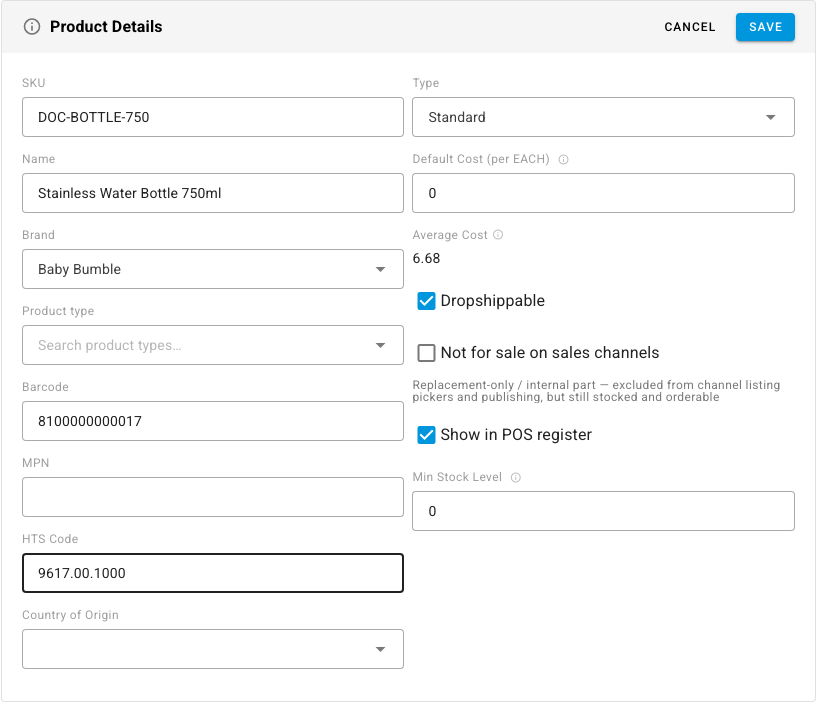
What you'll see: HTS Code and Country of Origin show on the Product Details card.
Fill them for many products
- Bulk edit: select products on the Products list and open bulk edit. HTS Code and Country of Origin are editable columns. See Bulk edit products.
- Import: add HTS Code and Country of Origin columns to a product import. Country of Origin accepts a country name or its code and is saved as the code. See Import products.
- Export: both are available as export columns, kept as text so spreadsheet apps don't mangle long codes. See Export products.
Where SKU.io uses them
| Where | What's used |
|---|---|
| Product imports, exports and bulk edit | Both fields. |
| Supplier price lists you export | HTS Code and Country of Origin columns. |
| Channel listings | Country of origin can fill a listing's country-of-origin field when you publish. |
| Walmart Fulfillment Services item setup | Country of Origin is sent with each item. |
| Airtable sync | HTS Code syncs as a product field. |
What they don't do
- No duty calculation. SKU.io doesn't work out duty from the HTS code. Record duty as a landed cost when the customs or broker bill arrives, and it's spread over the products' cost. See Add landed costs to a purchase order.
- Not on printed documents. Purchase order, packing slip and invoice templates don't print these fields, and SKU.io doesn't produce customs forms or commercial invoices. Your carrier or customs broker prepares those.
- Not sent to every shipping provider. Apart from the integrations listed above, carriers and 3PLs don't receive these fields from SKU.io. Enter them in the provider's own product setup where customs declarations need them.
Next steps
Last verified:
Was this helpful?